
The New Creative Workflow: How AI Is Transforming Sports Video Production Workflows

The Question Behind the Lens
or years, the craft of visual storytelling has relied on human intuition: going through long and manual production flows. But the landscape around us is shifting. Artificial Intelligence has entered the frame not as a distant concept, but as part of everyday creative workflows. It organizes footage, generates assets, predicts moments of interest, and accelerates processes once defined by repetition and manual effort.
And so, a fundamental question emerges: How far can artificial intelligence go
in reshaping creative production?
Can AI become a genuine creative partner, one that amplifies human imagination, or will it remain a powerful but ultimately functional tool? Can it help us think differently, not just work faster? And what does this mean for industries, like sports, where storytelling is intertwined with emotion and immediacy?
This new question sits behind every prompt, every generated frame, and every accelerated workflow, being at the heart of the transformation currently unfolding across sports video production.
AI in Action
The new era of sports video production
The state of play: how It was
Until recently, sports video usage demanded long and manual production and post-production processes. It was a reality shaped by craft, repetition, and human judgment, having technology as a support system, not a partner.
The turning point: how it is
AI has not replaced production; it has redefined its speed and intelligence.
Across the global sports ecosystem, automation is moving from a helpful feature to a foundational layer. Every phase of the workflow, capture, processing, editing, publishing, and distribution, is now infused with AI in some form.
The result is a new form of craftsmanship: faster, smarter, and enhanced by data.
From Capture to Consumption
How AI Reinvents Each Layer
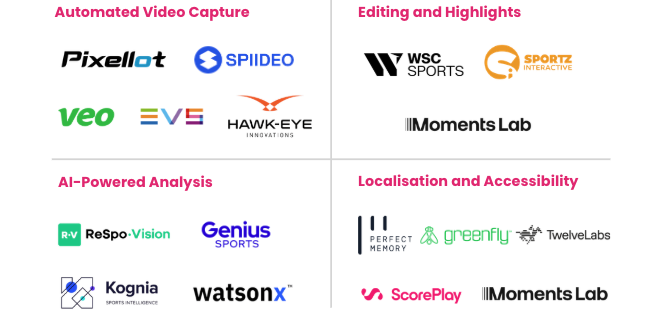
Automated Video Capture
For Tier 2 sports or competitions, what started as simple automation has become AI-directed production. Camera systems now track players, detect the ball, adjust framing, recognise objects, and adapt to environmental changes, all without human operators. In sports, this unlocks massive scalability: youth academies, grassroots clubs, and small broadcasters can now produce multi-camera-level content without a crew.
But the most important evolution is the collaboration between humans and machines.
Creators no longer spend energy on mechanical tasks, tracking, switching, and reframing, instead they focus on the emotion of the game, the story in front of them, and the creative choices that make a match unforgettable.
AI-Powered Analysis
Once limited to elite teams, AI-driven analysis is now woven into production environments. Algorithms detect events, goals, fouls, accelerations, spikes, and turnovers, all in real time. They analyse player movement, measure tactical patterns, and surface insights for both technical staff and fans.
Companies like WSC Sports, Stats Perform and many others featured in industry discussions are pioneering these real-time interpretations. They turn raw footage into structured data, enabling everything from instant highlights to interactive experiences powered by generative AI.
Imagine a match broadcast that answers a tactical question on demand, or a viewer asking: "Show me all the pressing actions involving Player X in the last fifteen minutes" and receive it instantly.
Editing and Highlights
Editing was once the bottleneck: hours of manual review condensed into minutes of storytelling. Today, AI handles the heavy lifting, identifying peak moments, adjust to video formats and automate the distribution across various platforms.
Clips appear on social media within seconds of happening on the field. Editors now step in not to search, but to shape: giving narrative polish to AI-generated timelines.
Localisation and Accessibility
One of the clearest revolutions in sports production is language.
AI dubbing, subtitling, and commentary tools, from players like CAMB.AI and Papercup, are redefining what “global content” means.
While those technologies are constantly evolving to become as close to perfect as possible, a match can now speak 140+ languages in real time, turning what used to be a costly editorial workflow into a scalable, multilingual operation. This shift changes business models entirely: rights holders no longer have to choose between reach and cost. They can speak to global fan bases and unlock new markets without multiplying production budgets.
The Human Layer
Creativity Meets Computation
As automation replaces repetition, what remains is the essence of storytelling.
Producers and editors are no longer footage managers; they are experience curators. AI serves as an always-on collaborator, suggesting cuts, flagging highlights, restructuring scenes, identifying emotional moments, and analyzing tone. But the choice of what feels right, that stays human.
The balance is delicate and essential.
AI brings consistency, speed, and precision.
Humans bring intuition, emotion, and context.
This is why the best sports productions continue to resonate: AI accelerates the process, but emotional impact still depends on human judgment.
The AI-Driven Future
How It Will Be
The next three to five years will define whether AI becomes the backbone of sports production or remains one powerful element of the pipeline. The trajectory is clear: more automation, deeper personalisation, and workflows that expand what creators and broadcasters can accomplish.
Editorial Freedom, Not Replacement
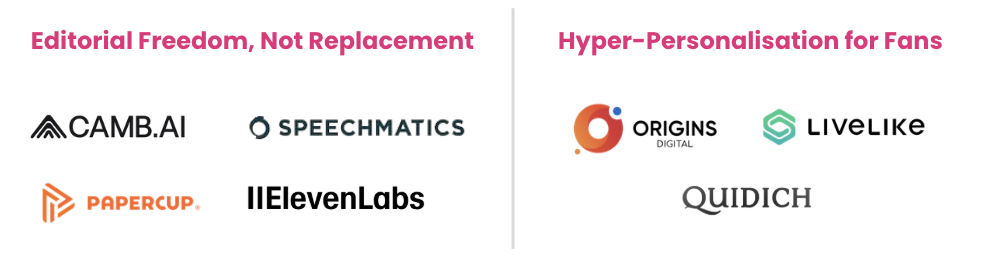
AI will soon automate up to 90% of repetitive editing tasks, but creativity will keep expanding.
When the friction of execution disappears, creators gain time to shape narratives, design formats, and explore new editorial angles. Future directors may brief an AI editing suite the way they brief an assistant editor today:
"Give me an edit that follows the emotional arc of the underdog team."
The difference is that the AI will return ten variations within minutes.
Hyper-Personalisation for Fans
Tomorrow’s fans will not all watch the same game in the same way.
AI will tailor feeds in real time:
tactical views for analysts
highlight streams for casual fans
social-layered broadcasts for younger audiences
creator-led angles integrated into official coverage
This is the beginning of the infinite broadcast, where each viewer receives a version optimised for their preferences, data profile, and platform behaviour.
Localisation at Global Scale
The true power of AI lies in delivering content that feels native everywhere.
A Champions League match watched in France and in Japan may be the same event, but the AI-localised experience will differ in tone, cultural cues, examples used, and editorial nuance. Not just translated, but adapted.
When sports content becomes culturally personalised at scale, the commercial horizon expands.
Data as Creative Fuel
AI is evolving from tagging footage to understanding meaning. Instead of clips labeled “all goals,” editors may soon receive: a momentum curve showing rising tension, fan sentiment peaks, and the key emotional swings of the match. This is where production becomes predictive: where data guides both operations and creative choices.
Challenges and Cautions
Creativity Still Needs Guardianship
The AI-augmented future is promising, but not without tension.
Questions around authenticity, trust, and control will shape the next wave of adoption.
Will fans accept AI-generated voices narrating their team’s most iconic moments?
Can leagues ensure that automated systems represent diverse audiences responsibly?
How will rights holders govern new dependencies, cloud infrastructure, data ethics, IP ownership, AI-generated content rights?
As noted in global industry discussions, responsible governance must evolve alongside technological capability. The future of production demands not just efficiency, but transparency and creative accountability.
LaSource is a sports consulting agency working closely with startups, tech innovators, and major sports organisations to accelerate growth, shape strategy, and unlock new commercial pathways