
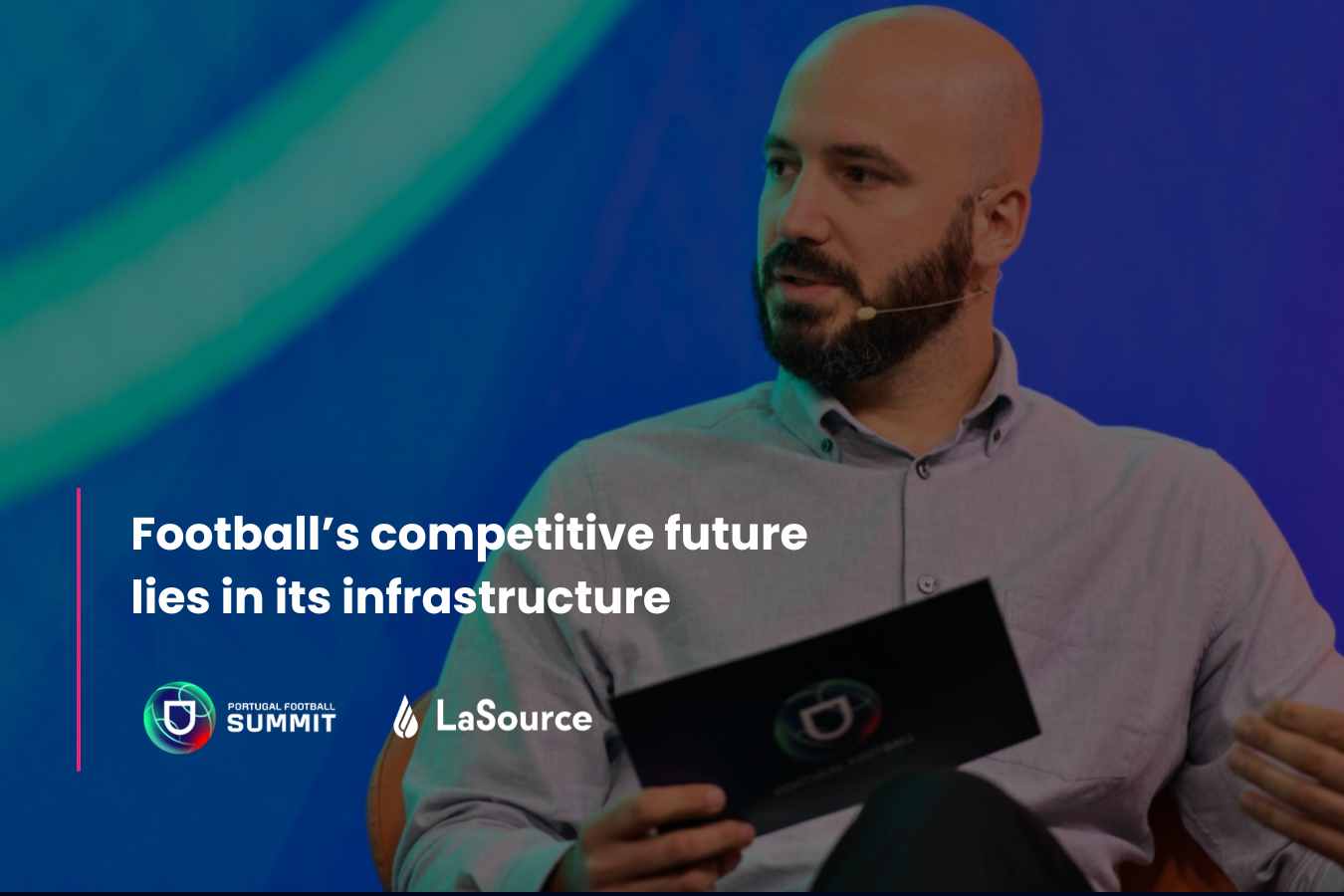
Our CBO, Leander Monbaliu, shares his perspective on how football is shifting towards a direct to consumer, data-driven model. He explores why the real challenge is no longer technology itself, but the infrastructure and capabilities behind it. This topic, with other key notes, is featured in his article in the Portugal Football Summit newsletter.
Spend enough time around the football industry - whether at conferences, in boardrooms, or in working sessions with leagues and federations - and a familiar narrative keeps coming back. Digital transformation is everywhere. Organisations are launching new platforms, redesigning apps, scaling their content operations, and investing heavily in data initiatives. On paper, it all points in the right direction. The industry appears active, forward-looking, and increasingly aligned with broader shifts in media and technology.
From the outside, it does look like a growing momentum.
But scratch beneath the surface, and the picture becomes more complex, and maybe even less convincing. This is not an industry short on ambition. If anything, ambition has never been higher. The issue we see is structural. There is a growing disconnect between what football organisations are trying to become and the foundations they are building on. Most still operate within a legacy B2B framework (defined by media rights, intermediaries, and fragmented ownership structures) while simultaneously attempting to behave like modern direct-to-consumer businesses. That contradiction is becoming harder to ignore, and it introduces friction into almost every strategic decision: how products are designed, how data is used, and ultimately how value is created and captured.
That tension is no longer sustainable.
The model is shifting
For decades, football operated within a relatively stable and predictable ecosystem. Media rights were centralised and negotiated in cycles. Distribution was controlled by a small number of powerful broadcasters. Fan relationships, while emotionally strong, were structurally indirect. They were mediated through third parties who owned the primary access points. For most organisations, this model was not only sufficient, it was highly lucrative.
But that environment has not gradually evolved, it has shifted.
Today, the industry is being compressed into something fundamentally different. Direct relationships with fans are becoming the primary interface through which value is created. Data is an asset that needs to be actively captured, structured, and deployed. Content has moved well beyond its traditional role as a communications tool and is now a central commercial and strategic lever.
At the same time, expectations are rising across the board. Fans expect personalised experiences, seamless cross-platform access, and real-time interaction. Technology cycles are accelerating, introducing new formats, platforms, and behaviours faster than most organisations are designed to absorb. What was once a relatively slow-moving, rights-driven ecosystem is now operating in a far more dynamic, fragmented, and competitive environment.
This is a structural shift towards ownership, and is not a linear transition from B2B to B2B2C.
The industry is solving the wrong problem
In response, many organisations are doing what feels logical: investing in tools. New apps, OTT platforms, CRM systems, fan engagement solutions, data warehouses. Each initiative is typically well-reasoned, often tied to a specific functional goal or short-term opportunity.
In isolation, these decisions make sense.
But collectively, they rarely add up to a system.
What is often missing is the infrastructure that connects everything together.The layer that determines how data flows, how products are built, how decisions are made, and how value is ultimately created and captured across the organisation.
Without that layer, complexity begins to outpace capability. Every new tool introduces additional fragmentation. Systems don’t communicate effectively. Data remains siloed. Teams operate with incomplete visibility. The organisation becomes reactive: constantly integrating, fixing, and adjusting rather than building forward.
Digital transformation, in this context, becomes a series of disconnected projects.
Not a system with compounding value.
Infrastructure is not a platform. It’s a control layer.
There is a persistent misconception that owning infrastructure means building everything internally. In practice, that is neither realistic nor desirable. The real objective is not ownership of every component, but control over the architecture that connects them.
A modern football organisation(whether a federation, league, or major club)needs to be understood as a system of interconnected layers: identity, data, content, distribution, and performance. Each layer has its own role, but their value only fully materialises when they are designed to function together, evolve together, and reinforce each other.
At the centre sits identity:a unified layer that connects every interaction, from grassroots participation and ticketing to digital engagement and national team fandom. Without it, there is no consistent understanding of the audience.
On top of that sits data:a centralised layer capable not only of aggregating information across touchpoints, but of activating it. This is where insight turns into action: personalisation, segmentation, product development, commercial targeting.
Content and distribution form another critical layer, but here the shift is conceptual. This is no longer about publishing content,but about operating a media ecosystem, where content is produced, packaged, distributed, and monetised across channels in a coordinated way.
Finally, there is performance data. Historically confined to the sporting domain, it is increasingly becoming a bridge between competitive advantage and commercial opportunity, feeding into fan experiences, storytelling, and new product creation.
When these layers are properly connected, the organisation starts to behave differently. Audience data becomes a monetisable asset rather than a reporting output. Content becomes a scalable product rather than a cost centre. New services can be developed and tested without rethinking the entire system each time. The organisation gains optionality,the ability to adapt, pivot, and create new intellectual property as the environment evolves.
This is where infrastructure becomes strategic.
The uncomfortable reality: technology isn’t the bottleneck
It would be convenient if the main challenge were technological. It isn’t.
There is no shortage of capable vendors across every layer of the stack. From CRM and CDP platforms to OTT infrastructure, analytics tools, and content systems, the market is well-equipped to support the industry’s ambitions.
The constraint sits within organisations.
Most are not structured to operate as integrated systems. Governance models remain siloed. Decision-making is fragmented. Internal capabilities in product, data, and technology are often limited or overstretched. The result is predictable: tools are implemented, but not fully leveraged. Data is collected, but not activated. Platforms are launched, but not properly integrated into a broader ecosystem. This is why organisations need to properly evaluate their internal capabilities and expertise. Now, in a world where AI is significantly accelerating, more than ever.
Because in most cases, technology does what it is supposed to do. Organisations however struggle to operate it in a way that creates sustained value.
Build vs buy is the wrong debate
One of the recurring questions in this transition is whether to build technology internally or buy it from external providers.
Framed this way, it is a false choice.
No organisation should attempt to build everything. At the same time, outsourcing the entire stack removes strategic control and creates dependencies that are difficult to manage over time. The infrastructure layer sits in between. It is about orchestrating best-in-class components within a coherent architecture.
The real question is not “build or buy.”
It is “where do we need control, and where do we need speed?”
Some layers(identity and core data, in particular)are too strategic to fully outsource. Others can be sourced externally with limited downside. Getting this balance right requires clarity on long-term objectives, technical architecture, and internal capabilities. Without that clarity, decisions default to short-term convenience, often at the expense of long-term flexibility.
Capability is the real differentiator
Even with the right infrastructure in place, systems do not operate themselves.
The organisations moving ahead are not necessarily those investing the most, but those building the right capabilities alongside their technology. They invest in product thinking, in data literacy, in cross-functional collaboration and human operability. They develop the ability to translate strategy into execution across multiple domains.
This is where many transformations stall.
Technology is implemented faster than the organisation evolves around it. Systems are introduced, but ways of working remain unchanged. Teams stay siloed. Decision-making frameworks do not adapt. The result is underutilised infrastructure and missed opportunities.
Again, the gap is therefore not technological, but organisational.
From reaction to foresight
What increasingly separates leading organisations is how they approach change.
They design for it. They invest in modular architectures that can evolve. They test early, through proofs of concept rather than large, irreversible commitments. They monitor weak signals, like shifts in fan behaviour, emerging technologies, new commercial models, and translate them into actionable scenarios.
This combination of strategic foresight and pragmatic execution reduces the need for costly improvisation later. It creates space to experiment, to fail in controlled ways, and to scale what works.
In a landscape shaped by AI, changing media consumption, and evolving fan expectations, this capability is an operational necessity.
The question has changed
For years, the industry asked whether it should move closer to the fan. Whether it should invest in digital. Whether direct-to-consumer models were worth pursuing.
Those questions are now behind us.
The more relevant question is whether organisations have the infrastructure required to operate in a world where direct relationships, data ownership, and continuous product development are the norm. Because in that world, competitive advantage will not come from isolated initiatives.
It will come from the system underneath.
A system that behaves less like a collection of projects, and more like an operating model,one that compounds value over time, adapts to change, and turns complexity into an advantage rather than a constraint.
And for much of football, that system is still being built.
Key takeaways
Football is moving from a rights-driven B2B model to owning direct relationships with fans, but most organisations still run on legacy foundations. That gap between ambition and infrastructure is where the friction shows up in almost every strategic decision.
Buying more tools is not the same as building a system. Apps, OTT platforms and CRM systems make sense on their own, but without a layer connecting identity, data, content, distribution and performance, each new tool just adds fragmentation.
The real constraint is organisational, not technological. Vendors already cover every layer of the stack, so what separates leading organisations is capability: product thinking, data literacy and ways of working that let them actually operate what they buy.
LaSource exists to help those shaping the next era of sport. We help sports organisations, technology companies and investors grow their business in sport through strategy, digital transformation and ecosystem partnerships. By combining strategic foresight with hands-on execution, we turn long-term ambition into initiatives that can actually be deployed and scaled.