
How Is 3D Tracking Changing the Way We Understand the Beautiful Game?

Sport has always been a game of margins. The clubs, leagues, and organisations that consistently find an edge are not always the ones with the deepest pockets. More often, they are the ones with the strongest foundations, the right capabilities, built at the right time, around information that others had not yet learned to use.
That moment is happening again. And this time, it is three-dimensional.
From Event Data to 2D to 3D: A Pattern Worth Understanding
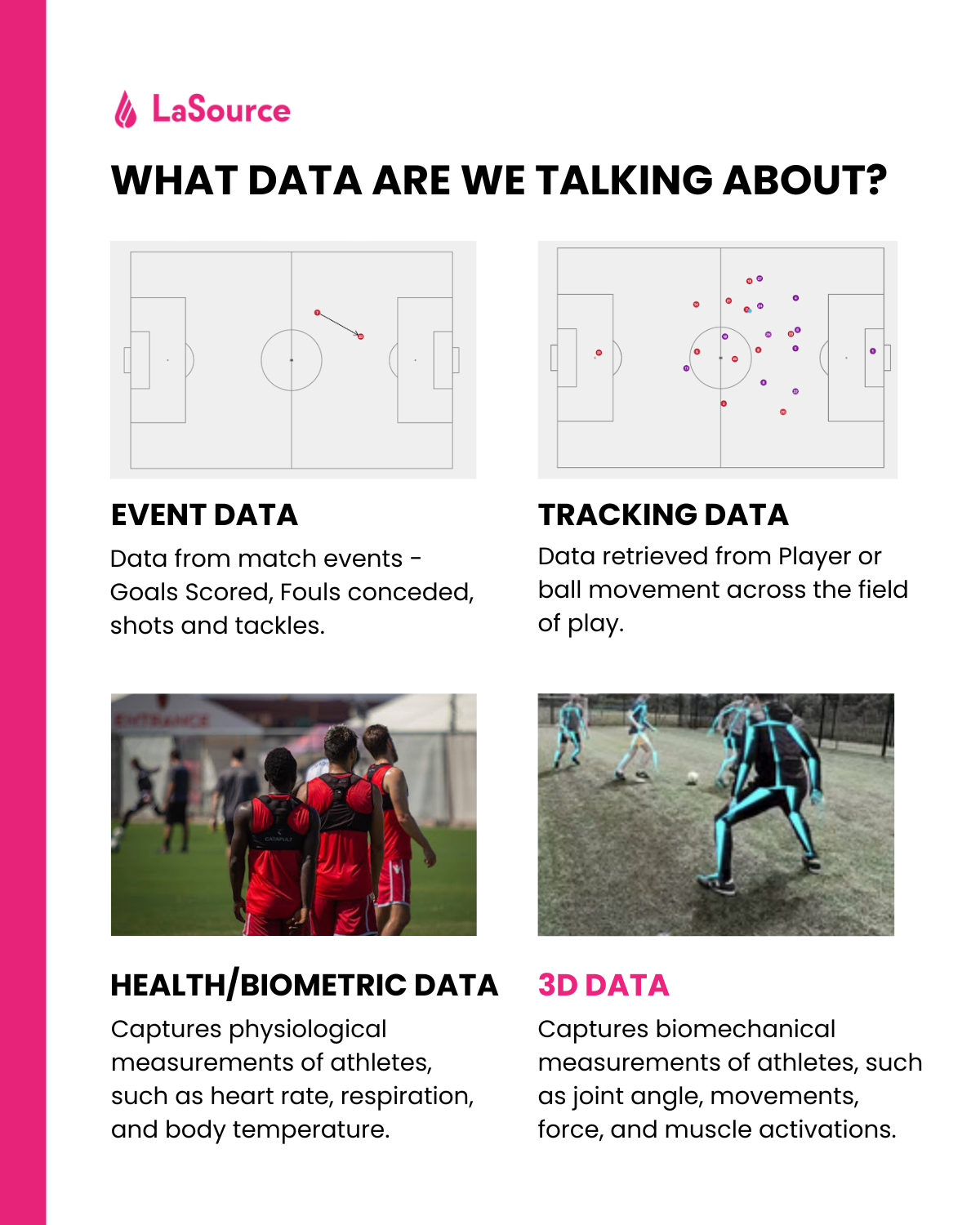
Let's go back to the early 2000s. Event data, goals, assists, shots, and cards were the currency of sports analytics. Then 2D tracking arrived, and with it came an entirely new dictionary: pressing intensity, spatial control, off-ball runs. Each shift followed the same logic: more data meant better understanding, and better understanding meant a competitive edge. Basically, what 3D data is to 2D data, what 2D data was to event data all those years ago. Leagues that built capabilities around it gained advantages that lasted years.
So what exactly changes with the move to three dimensions?
Where 2D tracking tells you a player was in a particular position, 3D data tells you how they were there. Body orientation. Movement mechanics. Scanning behaviour before a decision is made. Details that have always been part of the game but were simply invisible to our tools.
That perspective unlocks metrics that were previously out of reach. And those metrics, over time, will reshape how performance is evaluated, how talent is priced, and how competition is understood.
The Honest Picture: Where We Are Today
The reality is that the full transformative potential of 3D data is not yet being realised across the industry. Most current deployments and investments in the technology are concentrated in officiating and VAR use-cases. To an extent, leagues have invested in exploring how it can improve performance analysis, but this investment is speculative and hopefully will yield significant commercial gains from media, betting and digital products powered by this data. We have, however, seen some early commercial experiments. The Australian Open's volumetric replay experience on YouTube offered fans entirely new viewing angles of key match moments, while Trickshot's work with Etihad and Manchester City demonstrated how 3D data can power branded fan experiences at scale. These are early signals, but they point toward where the real commercial opportunity lies.But that framing applies only to the near-term, narrow use cases. The cost premium for live, high-quality 3D data is real, and the gap between data capture and producing commercially viable outputs persists. The economic model is still finding its shape. But the direction is not ambiguous. Companies like ReSpo.Vision is already democratising access to 3D tracking at scale, and the technological barriers are falling faster than most realise. The window to shape the terms of this market is open now — and, as with 2D tracking before it, it will not stay open indefinitely. The DFL has been a frontrunner in recognising this, working with LaSource on a number of strategic trend monitoring projects, with 3D data being one of them.
The Real Bottleneck Is Not the Data
Perhaps the most important insight from our conversations with industry practitioners is this: the problem is not a shortage of data.
Most sports organisations already have more data than they know what to do with. What remains elusive is the ability to derive meaning from it, specifically, the kind of meaning that influences decision-making.
Standard metrics have served their purpose. Expected goals, pass completion rates, pressing maps, they gave analysts a common language and made performance legible to boards and broadcasters alike. But they also flattened the game into proxies. The questions that matter most to coaches and executives, ‘why did we lose, what changes if we shift our defensive line, what is this player actually doing when she is not on the ball, ' are not answered by a dashboard.
3D data addresses some of this. But the real opportunity it unlocks is a different kind of intelligence entirely: AI systems that can analyse entire match environments contextually, understand cause and effect, and surface insights that go beyond description toward genuine explanation. As one contributor put it: "Coaches want to understand what changes in strategy or player behaviour impact results… AI engines could predict effects of tactical shifts, not just outcomes of games."
This is the direction of travel, and 3D data could be the foundation. The destination is understanding the game in ways that have never been possible before.
The Governance Question Every League Needs to Answer
The technology is only one part of the conversation. The other part, the one that tends to get less attention, is governance.
Who defines the standards? Who owns the infrastructure? Who determines what data can be used, and for what?
These questions have been largely left to technology providers in the past. That is not a criticism; it reflects how quickly the technology moved and how naturally standards follow whoever builds first. But as the ecosystem matures, there is a growing consensus that governing bodies need to play a more active role in defining what they want from 3D data, and for what purpose.
Leagues and federations are uniquely positioned here. They sit at the intersection of sporting integrity, commercial rights, and technical infrastructure. That positioning gives them both the authority and the responsibility to set the terms, rather than inherit them, which has long been the case.
The core elements that need standardisation are clear: consistent data quality, long-term comparability across seasons, low-latency reliability, and stable access interfaces for clubs. These form the structural backbone of any functional 3D data ecosystem. Without them, fragmentation is the outcome, and fragmentation erodes value for everyone.
What should remain a competitive advantage at the club level is a different question. Proprietary models, bespoke analytical frameworks, specialist in-house capability, these are legitimate differentiators, and they should be protected as such. But the governance conversation does not stop at the technical layer.
As one contributor noted: "Players should be part of the decision-making process and the redistribution of its fruits." As 3D data becomes more granular and more commercially valuable, the question of who benefits and who has a say will become impossible to ignore. The most forward-thinking leagues will address this now, rather than raising consent and revenue-sharing obligations later. The goal is not uniformity. It is a stable, equitable foundation on which genuine competition and trust can thrive.
The Broadcast Opportunity and the Consolidation Trend Defining It
We are going to be candid here: not all use cases for 3D data are equal, and the differences in commercial potential are more structural than you’d think.
Performance analytics, officiating, official data feeds, and betting data integrations are all genuine applications of 3D tracking, and they will continue to improve as the technology matures. But their economics are fundamentally linear. The customer base is defined. The value delivered per client is meaningful but limited. You have a visible ceiling. You can model revenue that grows, but grows predictably, in proportion to the number of clubs and leagues willing to pay a premium for better data.
The broadcast domain is categorically different. Its economics are more exponential than those of other use cases. And that distinction actually speaks volumes.
The cumulative fan base for major football leagues is in the billions. The broadcast products built on 3D data do not serve a defined set of professional clients; they serve every screen, in every market, in every language, simultaneously. The value does not accumulate client by client but compounds through rights fees, platform deals, advertising, betting integrations, second-screen products, and immersive experiences that do not yet exist but will be made possible precisely because 3D data provides the spatial richness needed to build them.
This is not speculation. The infrastructure for it is already being assembled. The Australian Open's volumetric replay experiment showed what is possible at the premium end. But the real scale comes when this becomes the default. When a fan watching a match anywhere in the world can choose their own camera angle, receive contextually personalised overlays based on the players they follow, access real-time tactical explanations rendered in three dimensions, or replay any moment of the game from any point in space. When that experience is as standard as HD broadcast is today, the audience it reaches, and the commercial products it supports, will open up a new commercial angle for rightsholders.
As one contributor put it: "In a world built on full 3D tracking from day one, it would feel almost absurd that every fan receives the same broadcast. Personalisation would be the default." Another was even more concrete about the downstream commercial implications: "We would see much denser on-screen content and significantly more integrations with external monetisation platforms… via affiliate links and second-screen invitations."
The major data players have already internalised this logic. The Genius Sports acquisition of Legend for $1.2 billion is the clearest expression of it. Genius now sits at every meaningful touchpoint of the sports fan journey, from official data feeds through to media distribution. 90% of their revenue sits outside performance. Even though they are not currently operating in the 3D data space, the tracking data was never the product. It was always the entry point. The return comes downstream, in the media and fan-facing layers built on top of it where 3D data will have a huge impact, should it become a big part of their business going forward.
With the current pace of evolution, we shouldn’t be surprised if in two or three years from now, we will just use whatever cameras are there and extract the data from them. When that inflexion point arrives, the cost arguments that have kept 3D tracking confined to elite competitions and organisations will dissolve. It will become democratic enough that the question is no longer whether broadcast-grade 3D data products are feasible. It will be whether your organisation already holds the infrastructure to benefit from them, or whether someone else built that position while you were still treating 3D data purely for performance.
What Needs to Happen Now
The path forward for any sports organisation venturing into 3D data is not complicated, but requires a clear understanding of priorities along this journey.
For leagues and federations, the strategic objective is broadcast. Performance and officiating use cases are valuable, but they are proof points along the way to the destination itself. The question worth asking now is not how to improve operations with 3D data, but what the broadcast product looks like when this technology is fully mature, and what rights frameworks need to be in place today to own that outcome. Standardising the data infrastructure layer is a prerequisite for building commercially viable media products at scale.
For clubs, the case is different. Even though broadcast-driven use cases are most exponential, clubs do not hold broadcast rights. The most significant commercial event in a club's financial year is rarely a matchday; it is a player sale. And the value of a player sale is determined by how precisely you can describe what a player actually does on the pitch. How they move. How they position themselves before a decision. What they do in the 89% of the game when they are not on the ball. 3D data makes those qualities legible and transferable in ways nothing else currently can. For clubs, this is fundamentally a player valuation tool, and the return is direct and measurable.
Across both, the window to shape the market rather than inherit it is open now. The major platform players are already acquiring their way toward full-chain ownership of sports data, media rights, and fan touchpoints. Sports organisations that establish their frameworks and partnerships today retain leverage. Those who wait risk becoming data suppliers in someone else's ecosystem.
Key takeaways
3D data tracking measures how a player moves, not just where they stand. It picks up body orientation, movement mechanics and how a player scans the pitch before they get the ball.
3D data has a wide range of uses, from refereeing and VAR to performance analysis, official data feeds and betting. Most of the investment so far has gone into officiating, with performance and commercial products still developing.
The biggest commercial opportunity is broadcast, because it serves multiple markets and screens at the same time. One dataset can power personalised angles, overlays and second-screen products for millions of fans at once.
FAQ
How can football clubs use 3D data?
Clubs can use 3D data for player analytics and player development, getting a precise read on how a player moves, positions themselves and scans the pitch before a decision.How can leagues and federations use 3D data?
Leagues and federations are the ones at the steering wheel, sitting across sporting integrity, commercial rights and technical infrastructure. That position lets them set the standards for data quality, comparability and access.How can rightsholders use 3D data in broadcasts?
Rightsholders can build products that let a fan anywhere choose their camera angle, get overlays personalised to the players they follow, and replay any moment from any point in space.
LaSource is a global sports consulting agency specialising in sports technology, data, media, and commercial innovation. LaSource works with sports organisations and technology companies to support international expansion, market positioning, and long-term commercial development.