
Analysis on Coca-Cola’s new Loyalty Program for the Premier League & The NHL and FC Bayern Munich’s partnership
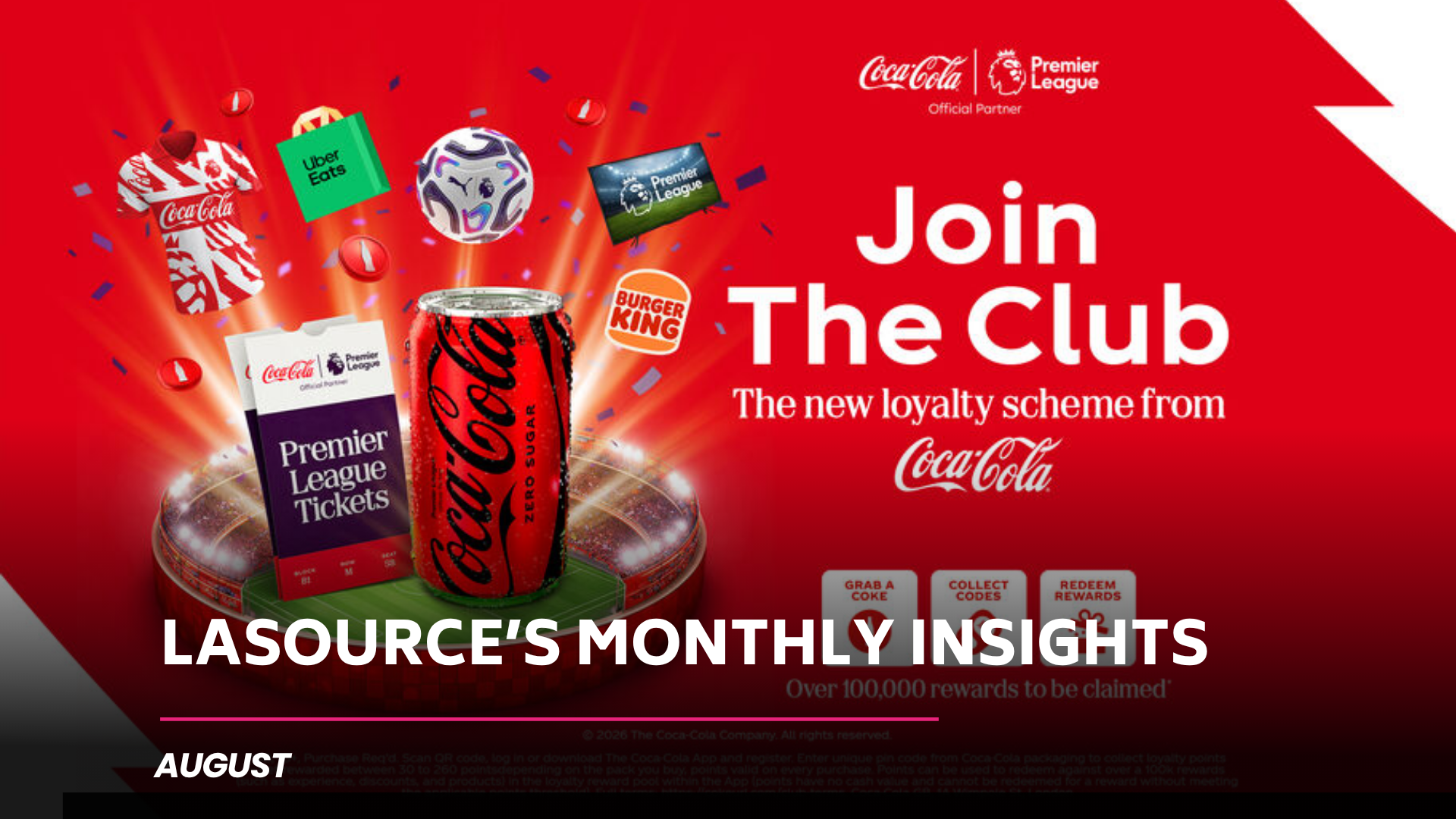
Coca-Cola launches 'The Club' Premier League loyalty scheme
The Coca-Cola Company has announced a new three-year partnership with the Premier League, signalling the brand’s return to the world’s most-watched football league.
Alexandre Kandelaft, our Head of Tech Consulting, shares his opinion on Coca-Cola's involvement in sport and how loyalty is 2 way street and how the Premier League stands to gain just as much as the beverage brand
Our Take:
On 3 August, Coca-Cola launched 'The Club' in Great Britain, a new loyalty programme built on the back of its Premier League partnership.
The principle has nothing really revolutionary on paper. You buy a pack, scan the QR code or enter the pincode in the Coca-Cola app, collect points and then spend them on rewards or take an instant win. The company says there are over 100,000 rewards in the pool, including vintage Premier League jerseys, match tickets, hospitality and money can't buy experiences. But still, I believe these activations are always interesting with both sides getting something out of it.
Coca-Cola has always been a lot into football. It has partnered with FIFA since 1974 and has backed the UEFA European Championship since 1988. Its Euro 2028 renewal will make 40 years and an 11th consecutive tournament. It came back to the Premier League as Official Soft Drink Partner on a three-year deal from 2025/26. In the US it sits behind MLS, US Soccer at once. And no later than this week, it renewed with Paris Saint-Germain through 2029, including 400,000 limited-edition collector cans landing in more than 650 Carrefour stores in Île-de-France from 12 October. All of that to say that Coca-Cola takes football as an operating model rather than a media buy, and the company has started showing what it gets back. CEO Henrique Braun said the FIFA World Cup and America 250 campaigns delivered over 25 million first-party data points and more than 9 million digital and social views, alongside 5% trademark Coca-Cola volume growth in the quarter, its strongest in 17 years excluding COVID recovery.
From the Premier League perspective, it has already the audience. What Coca-Cola brings to it is visibility. The Premier League is broadcast to 189 countries with a global audience above 1.5 billion. It does not need help being seen. But still, it does not own the supermarket. Coca-Cola's World Cup activation alone ran through 20 million retail outlets, and every can is branding in a corner shop, a meal deal, a fridge at eye level, in front of people who are not watching a match and may not follow the league at all. Broadcast only finds people who already turned up. Coca-Cola is one of the most recognised names on earth and has spent a century selling togetherness rather than performance. A league usually discussed in terms of money and broadcast rights gets to borrow some of that warmth. The scheme is Great Britain only for now, but the model travels and Coca-Cola has the shelf space to travel it.
Now, if we take a closer look at the mechanics of the loyalty scheme, there are some details standing out. Points scale with pack size, and Supercans earn double. Also, there are two currencies. Balance Points accumulate and will expire on August 2027. Tier Status Points reset every 90 days and set your membership level. That reset is the part I found very interesting. A balance that only goes up is a savings account, and people tend to forget savings accounts. A tier that decays gives you a reason to buy this month rather than next year. Airlines have run it for decades, and it is the difference between a promotion and a habit. The second thing worth noting is that most of the rewards are objects. I made this argument recently about the J.League's eco-bags and it holds here as well. A digital points balance is easy to forget, a jersey a fan earned is not. It goes on a shelf or on a back, and it keeps working for years. The co-branded pieces are the ones I would watch over time. A Coca-Cola x Premier League scarf that was never sold, only earned, inside a fixed window in 2026, is exactly the kind of object that gets interesting a decade later. Coca-Cola has been in the collectables business since long before anyone called it that; its trays, bottles and signs have their own collector market. PSG's 400,000 collector cans are the same idea, printed. Scarcity is the product. Here the risk sits in the gap between "over 100,000 rewards" and the rewards people actually want. Hospitality with a legend or a day at a training ground goes to a handful of winners, and everyone else gets a voucher, a Sky Sports package or nothing. If the collecting is not enjoyable on its own, the scheme becomes a lottery with a very long queue. And to me, the programmes that last are the ones that make the earning fun, so winning is a bonus rather than the only reason to play.
To conclude, these crossovers keep happening because each side holds what the other lacks. The Premier League has attention and identity. Coca-Cola has distribution and a purchase moment. Mix them together with a points scheme and you get a route from watching to buying, and from buying to a relationship you can measure and repeat. For rights holders, a sponsor's shelf is now a media channel worth negotiating for, not a logo placement to be priced. For brands, the prize cabinet is the product. Get the objects right and fans will do the rest.
Key takeaways
A tier that decays beats a balance that only grows. Points that reset on a 90-day clock give a fan a reason to buy this month, which is the difference between a one-off promotion and a habit.
Physical, earned rewards outlast digital ones. A jersey or co-branded scarf a fan won inside a fixed window goes on a shelf or a back and keeps working for years, where a points balance is easy to forget.
For a rights holder, a sponsor's distribution is the asset to negotiate for. The Premier League already has attention; what Coca-Cola adds is the supermarket shelf and a purchase moment, a route from watching to buying to a relationship you can measure.
FAQs
Why is Coca-Cola's "The Club" Premier League loyalty scheme smart business, not just a promotion?
Its tier status resets every 90 days, so fans have a reason to buy now rather than later, turning a discount into a repeatable habit. Points that only accumulate get forgotten like a savings account.Why do physical rewards work better than digital points in a loyalty scheme?
An object a fan earned is kept, worn and displayed for years, while a digital balance is easy to forget. Scarce, earned items keep the brand present long after the campaign window closes.What does the Coca-Cola and Premier League deal mean for leagues and clubs weighing sponsorships?
A sponsor's shelf space and purchase moment are now a media channel worth negotiating for, not a logo to be priced, because they reach buyers a broadcast never finds.
NHL and FC Bayern Munich announce multiyear partnership to grow hockey in Germany
The National Hockey League (NHL) and FC Bayern today announced a first-of-its-kind strategic multiyear partnership designed to accelerate the growth of hockey in Germany and the development of FC Bayern in North America, create innovative fan engagement opportunities and connect two of the world's most iconic sports brands and passionate fan bases.
Philippe Souche, our Account Manager, shares his take on how two rightsholders agreeing to a cross-sport partnership is a small (relatively) sign of the way the biggest sports brands now operate beyond the sport that built them.
Our Take:
What Germany gets is the obvious part. NHL regular-season games over the next couple of seasons, starting in Düsseldorf this winter and moving on to Munich and Cologne in 2027, featuring players Germany already knows, Leon Draisaitl among them. What makes it interesting is everything sitting around those fixtures, because that is what turns a cross-border tour stop into a genuine brand partnership: co-branded content, street hockey activations, matchday experiences and watch parties at Bayern's own stadium, and joint grassroots programming for young fans. It builds on a broader international growth strategy the NHL has been rolling out in Germany over the past year or so, including grassroots investment and a hockey-themed fan engagement event earlier in 2026. In exchange, the NHL is helping Bayern grow a footprint, and a fan base, of its own in North America.
That last part is easy to miss, and it's probably the most revealing piece of the whole announcement. This isn't Bayern lending its name to a league that needs a leg up. German ice hockey has had a genuinely strong few years by itself, with crowds, sponsorship revenue and fan interest building steadily without any NHL involvement at all.
What the NHL is missing, and what a purely domestic hockey story can never hand it, is a route into the millions of people in Germany who follow football closely and ice hockey barely at all. That's Bayern's audience, and it wasn't built by winning matches alone. It came from treating the club itself as a brand, something marketed, exported and monetised well beyond match day, in much the same way a media company or a consumer goods name would be.
The exchange runs both ways, and that's really the point. Bayern already commands a large, loyal following and real brand equity in football markets it has spent years cultivating through sponsorship deals and commercial partnerships of its own. What it wants out of this is the reverse: a route into North America, where an NHL partner can open doors that a European football club, however big at home, doesn't carry with it automatically. Neither side is doing the other a favour here.
Each is using the partnership as an audience development play, reaching a fan base the other one already has easy access to, and that's a cleaner way to think about it than "hockey coming to Germany" or "football club sponsors hockey league," with both organisations hoping the interest turns into ticket sales and lasting loyalty rather than fading once the novelty wears off.
It also helps that this isn't happening from a standing start. The NHL has quietly tested the German market on and off for years, through preseason and exhibition games, and it already has a handful of well-known German players to build a marketing story around rather than having to invent one. There's already something for German football fans to recognise once a sponsorship activation or digital campaign points them toward it.
The more interesting question is what that access is actually worth once it exists. An audience built through street hockey pop-ups and watch parties is not automatically a commercial asset. The real test is whether it turns into something a sponsor or a broadcaster will pay for: a brand that wants a single campaign to reach football fans and hockey fans at once, or a German broadcaster deciding that NHL games are now worth a proper rights fee rather than a single fixture squeezed into the calendar. The same goes in reverse for Bayern in North America. Right now, both sides are still building the audience they'd eventually want to sell.
Bayern's own answer to that question might already be taking shape elsewhere. We wrote back in January about the NBA quietly testing investor appetite for a wholly owned European league, and that project has moved on a long way since: a 2027 launch is now the target, and Bayern is reportedly among the football clubs in advanced talks to own a franchise in Munich. Put next to the NHL partnership, it makes for a useful contrast. With the NBA, Bayern would be buying equity in a league built and run from the top. With the NHL, it's trading reach without taking any stake at all. But step back, and both moves point at the same underlying shift: a club like Bayern isn't really behaving like a football team when it makes decisions like these. It's behaving like a brand that happens to have a football team at its centre, confident enough in its own pull to strike a marketing partnership in one sport and go after ownership in another, in the same year, in neither case because of anything to do with why people started following it in the first place.
All of this sits inside a broader lesson for sports business more generally, and the NHL isn't the first American league to try it. The NFL struck a similar multi-year deal with Real Madrid to play at the Bernabéu, paired with a flag football development programme in Spain, so this way of entering a market already has a track record to watch. When a rights holder wants to enter a market where a strong domestic alternative exists, the instinct is often to compete with it head-on or to go around it entirely through a straight sponsorship or media rights deal. This partnership points at a third option: trade audience access with a brand outside your own sport now, and hope the commercial deals follow once that access is proven. It also helps if the two brands share more than an overlapping audience, some real common ground in identity or values, rather than two logos that simply happen to reach different crowds. Whether that works out for the NHL's growth strategy in Germany will take a couple of seasons to know. But as a piece of sports marketing thinking, it's a strategy worth taking seriously, and it's the kind of question we spend a lot of time working through with the leagues, federations and rightsholders we advise on market entry and fan engagement strategy.
Key takeaways
This is an audience swap, not a favour. Each side is buying a route into a fan base the other already owns, the NHL into Germany's football following and Bayern into North America, so both are developing audiences rather than one propping up the other.
Trading audience access is a third route into a market. Instead of competing with a strong local player head-on or buying in through a straight sponsorship, a rights holder can swap reach with a brand outside its sport and let commercial deals follow once the access is proven.
A built audience is not yet a commercial asset. Watch parties and street hockey pop-ups only pay off if they convert into something a sponsor or broadcaster will pay for, so both sides are still building the audience they eventually want to sell.
FAQs
Why did the NHL and FC Bayern Munich agree a cross-sport partnership?
Each wants a route into a fan base the other already owns: the NHL into Germany's large football audience, and Bayern into North America. Both treat it as audience development, not one side helping the other.What does the NHL and Bayern partnership show about how big clubs now operate?
A club like Bayern increasingly behaves like a brand that happens to have a football team, striking a marketing deal in one sport and chasing league ownership in another in the same year. Its pull comes from brand equity, not results alone.What does the NHL and Bayern deal mean for leagues and federations entering a new market?
It offers a third option beyond competing head-on or buying a straight sponsorship: trade audience access with a brand outside your sport, and let commercial deals follow once that access is proven and the two brands share real common ground.