

Benfica invests in education with creation of Benfica Institute for Sport Excellence
Why is Benfica opening a school? Clément Laverdine, our Head of Strategy Consulting, looks at how sports organisations can turn the expertise they already have into a product, a new revenue line and a fan touchpoint, and what it takes to build one.
Inside view
“Looking three years ahead, success for the Benfica Institute will go beyond the number of courses delivered. Our ambition is to establish a global reference in sports education, knowledge and innovation, transforming Benfica’s expertise into meaningful opportunities for professionals, organisations, and partners worldwide.
Through our educational programs, academic partnerships and Benfica XChange, we want to build an ecosystem where knowledge flows both ways: sharing what makes Benfica a reference in sporting excellence, while bringing new ideas, research and innovation back into the club. Ultimately, success means creating lasting value for Benfica and contributing to the development of the wider sports industry." - Lourenço Ferreira, Global Expansion & International Business, Benfica
Clément’s analysis:
Let’s look at what Benfica is building... and what it means for other sports organisations.
The Institute opens with six courses in Portuguese and English, taught largely by club staff alongside academics, online and at Benfica Campus. Next to them, Benfica Xchange lets researchers, companies and sports organisations propose research projects, product tests and tailored programmes. Behind the announcement sit three questions any sports organisation looking at education should ask: what can we sell, who will buy it, and what does it bring back beyond revenue?
First, every sports organisation sits on expertise it can sell, starting with what it is known for.
Clubs, leagues and federations build up expertise across performance, management, marketing and technology. Most of it stays internal. Packaged into courses, programmes or certifications, it becomes a product, and the brand does much of the work of reaching people willing to pay to learn from it.
The natural starting point is the expertise the market already recognises, which is why Benfica opens with a course on its player development methodology. Once the first courses prove their quality, the catalogue can move further from the core, as Benfica is doing with performance analysis, marketing and, from 2027, football finance. As the catalogue grows, each course still has to find the right balance: share enough to be worth paying for, and keep the know-how that gives the organisation its edge.
Second, the market is global, and it covers three audiences.
Education can reach professionals who want to improve, people trying to get into the industry and fans who want to understand the game better. Professionals look for depth and recognition, and their employers can cover the cost. Newcomers look for credibility and a way in. Fans look for a closer view of the club they follow. Online delivery lets the same catalogue reach all three in any market.
The additional cost is lower than it looks, because courses build on what the organisation already has: its staff, its facilities, its methods and its existing programmes. What it does need is a well-structured project, managed properly from the start.
Third, education is also a fan touchpoint and a source of market insight.
Every learner is a known person, with a country, a role and an interest. For fans, a course is a strong way to engage with the club and, once they opt in, a way for the club to know them better. For the organisation, enrolments show which markets are curious, which topics travel and where to open camps, academies or partnerships next. That value only appears if the learning platform connects to the CRM. Run on its own, it produces revenue and nothing else.
Beyond the announcement, something bigger is happening: education is becoming one piece of a wider knowledge ecosystem.
Education rarely stays a set of online courses. The usual path runs from online to hybrid, then on-site programmes, then university partnerships that turn certificates into recognised degrees. Benfica already mixes online learning with sessions at Benfica Campus, and Real Madrid has run postgraduate programmes with a university partner for years.
It also connects naturally with innovation. Barça Innovation Hub, Real Madrid Next and PSG Labs bring outside start-ups and experts into the club, and Benfica Xchange does the same inside the Institute. Teaching what you know and testing what others bring are two sides of the same platform.
The natural question now is: is education only for elite clubs with a famous academy? Far from it. Federations already run coach education as part of their mandate and can open it to new audiences. Leagues hold know-how on club management and commercial operations that other leagues would pay to learn.
At LaSource, we believe that the hardest part of an education project is organisational. It needs strong project management, a clear owner and the involvement of all the stakeholders whose knowledge is being taught, from coaches to commercial teams, who already have full-time jobs. It also needs a roadmap: which audience first, which format next, which partner later.
To learn more about how sports organisations can build revenue beyond their core business, you can explore our piece “How can sports organisations diversify their revenue?”
If you’re sitting on expertise you’ve never packaged, or thinking about where education fits in your growth plan, happy to discuss!
To dive deeper and get a first-hand view of what Benfica is building, head to their website or education platform.
Key takeaways
Every sports organisation sits on expertise it can package and sell. Performance, management and marketing know-how usually stays internal, but turned into courses it becomes a product the brand itself helps sell.
Education reaches three audiences at once: professionals, newcomers and fans. Online delivery lets one catalogue serve all three in any market, and the added cost is low because it builds on staff, facilities and methods the organisation already has.
Beyond the fees, the real prize is data. Every learner is a known person, so enrolments reveal which markets are curious and which topics travel, but only if the learning platform connects to the CRM.
FAQs
Why is Benfica opening an education institute? To turn the club’s internal expertise, starting with its player development methodology, into a paid product, a new revenue line and a fan touchpoint. The brand does much of the work of attracting people willing to learn from it.
What does launching an education arm mean for clubs, leagues and federations? Each already holds expertise others would pay to learn: clubs in performance and methodology, leagues in club management and commercial operations, federations in coach education they can open to new audiences. Any organisation with real expertise can build one, whatever the size of its academy.
What does a sports organisation need to make an education project work? Strong project management, a clear owner and the involvement of the staff whose knowledge is being taught, plus a roadmap of which audience, format and partner come first. The learning platform also has to connect to the CRM, or it produces revenue and nothing else.
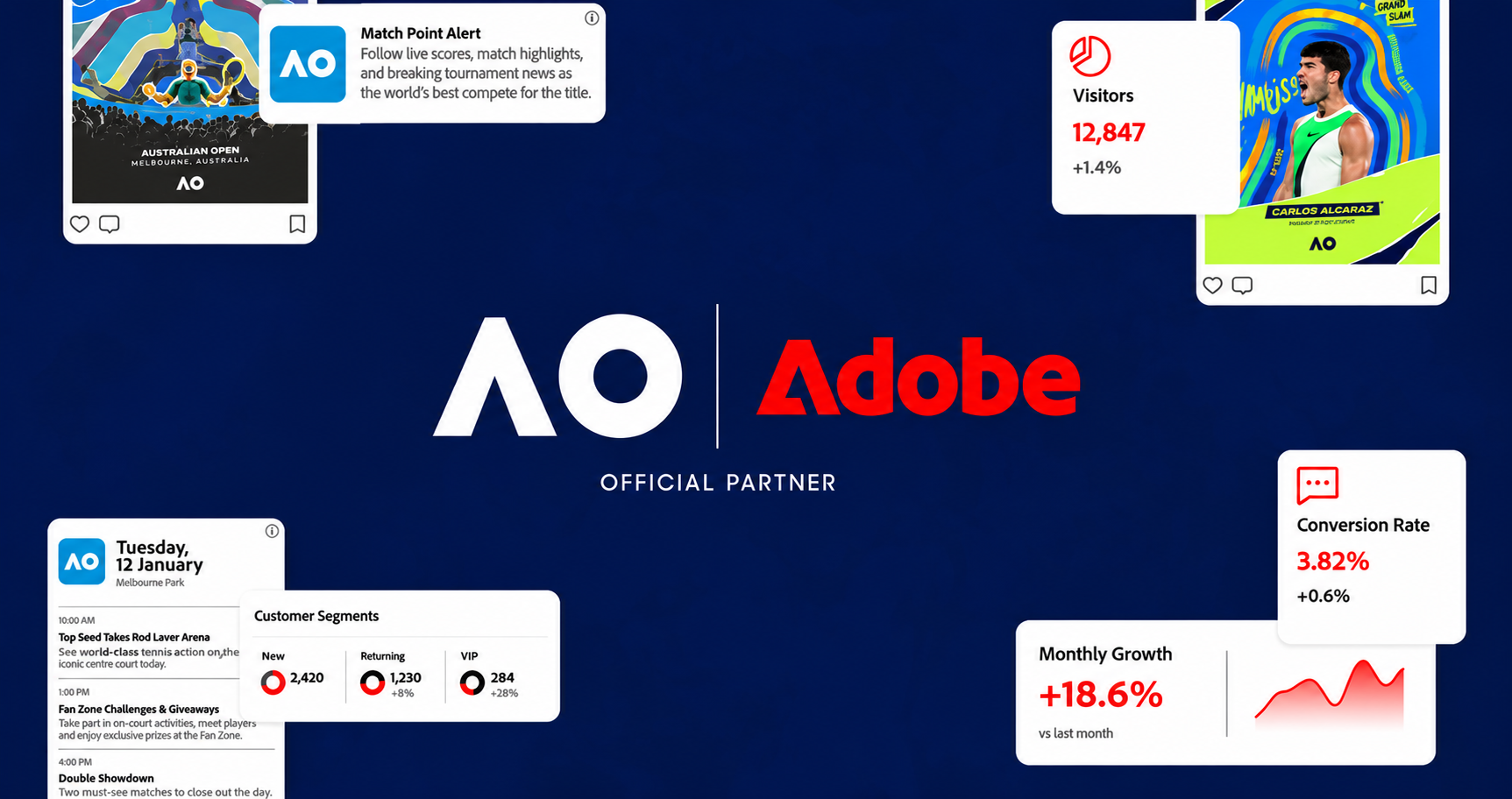
Adobe’s AI and CX platform to power personalised fan journeys at the Australian Open
Why is the Australian Open signing a software company as a sponsor? Philippe Souche, our Customer Success Manager, looks at how sponsorship is turning into infrastructure, and why the first-party data underneath matters more than the AI tools on top.
Philippe’s analyses:
Most sponsors of a Grand Slam sell something you can see: a car, a watch, a drink, an airline seat. Adobe sells software that sits behind a marketing team. Tennis Australia has named it the official AI marketing and creativity partner of the Australian Open, in a multiyear and phased agreement, and it is Adobe's first tennis sponsorship anywhere in the world.
The ambition is clear. The Australian Open wants to move from a sports event that peaks for two weeks in January to a continuous, personalised relationship with its fans. Tennis Australia will use Adobe CX Enterprise to connect its data and digital systems, so that what each fan sees, online and on site, reflects their interests: suggestions for matches, food and activities, content adapted to international audiences, and AI tools to create and share their own tennis content.
The timing makes it hard to file under fan experience and move on. Two weeks earlier, the NHL named Adobe its official creative, marketing and AI partner, with all 32 clubs given access to the same platform. In March, MLB widened its own agreement, which now includes presenting Opening Day through 2028. Three major properties in seven months, one software vendor.
From logo to infrastructure
Traditional sponsorship trades exposure for money. This kind of deal trades something closer to operations. Adobe is built into the fan engagement strategy rather than placed next to it: its product shapes how content is produced, which fan sees which message, and where each fan record lives. For Adobe, that means a reference customer in Asia-Pacific. For the rightsholder, it means a way to scale personalisation beyond one market, which the NHL itself describes as the limit of today's market-by-market experiments.
What the announcements do not say is how the deal is built. Is it a sponsorship that includes technology, or a technology contract with a sponsor's name attached? Neither the fee nor the terms have been shared, and the answer decides who holds the stronger hand at renewal.
A long game, whatever the press release says
The rightsholders that have made this work did not start with an AI feature. Wimbledon and IBM have worked together for more than 35 years, from the first website in 1995 to the first AI-powered tools, and this year the tournament rebuilt its app and website around a new data architecture. IBM and the All England Club report that engagement rose 16% in 2025 and that myWIMBLEDON registrations, fans who have put a name to their interest, grew 39%. The PGA TOUR has built on Adobe since 2012, combining CRM and digital data into a single view of each fan.
Newer deals are arriving faster than their results can be judged. The Premier League named Microsoft its cloud and AI partner in July 2025, for five years. Like the NHL's announcement with Adobe, it does not say who owns the resulting fan data.
The data is the real asset
The AI features are the part fans will see. What decides whether they work is underneath. A year-round relationship depends on knowing who a fan is across ticketing, the app, newsletters and partner activations, in countries with very different habits and rules on consent. Joining those records is slow, unglamorous work, and no platform does it on its own.
There is a second consequence. If the same platform runs across the NHL, MLB and the Australian Open, the tools stop separating one rightsholder from another. What remains is the quality of each one's first-party data. The advantage moves from what you buy to what you have already built.
The tournament in January is the obvious place to look, and it will be worth watching less for what the AI creates than for what Tennis Australia can do with the data it has connected. That is the order we follow with the leagues, federations and tournaments we advise: what fan data you hold today, where it sits, who can use it, and only then which tools to plug in. If you are mapping that out for your own organisation, we would be happy to compare notes
Key takeaways
Sponsorship is turning into infrastructure. When a software partner shapes how content is produced, which fan sees which message and where each fan record lives, it is built into operations rather than placed beside them as a logo.
When everyone runs the same platform, the tools stop being the advantage. If the NHL, MLB and the Australian Open all use the same vendor, what separates them is the quality of their own first-party data, so the edge moves from what you buy to what you have already built.
These deals are a long game, and ownership is the unanswered question. The rightsholders that made it work spent years joining up their data, and agreements that stay silent on who owns the resulting fan data leave the most important point open.
FAQs
Why is the Australian Open signing Adobe, a software company, as a sponsor? To move from an event that peaks for two weeks in January to a year-round, personalised relationship with fans, using Adobe CX Enterprise to connect its data and digital systems. The partner is built into the tournament’s operations rather than placed next to them as a logo.
What does the shift from sponsorship to infrastructure mean for leagues, federations and tournaments? When a technology partner runs the fan engagement stack, the tools no longer set rightsholders apart, so the advantage comes down to the quality of their own first-party data. Before plugging in any platform, they should know what fan data they hold, where it sits and who can use it.
Why does first-party data matter more than the AI tools in these deals? A year-round fan relationship depends on knowing who a fan is across ticketing, the app, newsletters and activations, which no platform joins up on its own. The AI features are what fans see, but the connected data underneath is what decides whether they work.
LaSource exists to help those shaping the next era of sport. We help sports organisations, technology companies and investors grow their business in sport through strategy, digital transformation and ecosystem partnerships. By combining strategic foresight with hands-on execution, we turn long-term ambition into initiatives that can actually be deployed and scaled.