
How is Football Analytics Moving From “How Do I Win?” to “How Do I Win My Way?”
How football analytics is shifting from generic, shared metrics toward proprietary, identity-based intelligence, and what that means for clubs, academies, and federations
A few years ago, metrics like expected goals (xG) felt advanced. Now a club can measure something as specific as a player's goal conversion rate after a high-intensity 15-metre run into the attacking third from the left wing. And it does measure it. Which changed football.
Ten years ago, the players who touched the ball most were the midfielders — the classic playmakers pulling the strings in the centre of the pitch. Today that is shifting toward the centre-backs. Premier League teams now build play patiently from the back, so the defenders are the ones with the ball more than anyone. In fact, eight of the ten players with the most passes last season were central defenders, compared with only four ten years ago. The only reason we can say any of this with confidence is data. Data turns a feeling about how the game has changed into something that can be agreed on.
In this article, we look at where football analytics is heading next: the main challenges clubs and federations face with data analytics as it works today, practical solutions and real use cases, and how those solutions apply across a whole sporting ecosystem, from the first team through recruitment and academy, and beyond.
Football has more data available than ever before
It started with event data: simple things like goals, shots and tackles. Then the industry moved to tracking data, which made it possible to see how players and the ball move across the pitch. On top of that sits health and biometric data, such as heart rate and respiration. And most recently, 3D data, which captures body orientation, joint angles, and even where a player is looking before a decision.
But the open question is whether all this data has actually brought more clarity?
In many ways it has. Measuring the game was a real step forward, and clubs understand performance today in ways they simply could not a decade ago. But more data has also created a new kind of ambiguity. Part of it is practical: performance data arrives from many providers, in different sources and formats, and stitching it together is slow and expensive. A club that can pool every source and take the best from each, rather than being locked into a single provider's format, removes a real bottleneck. And there is a deeper issue beneath the surface, one that shows up even when clubs use different suppliers.
Everyone is working from the same data pile
Teams are largely using the same pool of data, described by the same standardised metrics, and this is where the problem begins.
When every club measures the game through the same lens, every club tends to reach the same conclusions. If ten sporting directors are all looking for a left-back with strong progressive passing and high sprint numbers, they will all be looking at more or less the same shortlist of players, and bidding against each other for them. The metrics are generic, so the shortlists are generic too, regardless of whether those players actually suit how a particular team plays.
This surfaces four connected challenges.
Translating identity into measurable objectives
Most coaches have a clear vision for how their team should play. Turning that vision into objective, repeatable and comparable data is far harder, because the available metrics were designed to describe football in general, not a particular club's version of it.
The off-ball and training blind spot:
The ball is only in one player's control at a time, which means standard event data captures a tiny fraction of what is happening: the movement of the other players, the runs that pull defenders out of position, the decisions made away from the ball. Most of this goes unrecorded. So does almost everything that happens in training, where habits are actually built. Industry estimates suggest that today's analytics capture well under 1% of what unfolds in a match, with roughly 88.5 minutes per player per game spent off the ball. That is far too much of the game still left to the naked eye.
The fragmented academy:
In many clubs, the first team, the academy and the scouting department each work to their own reference points. Without a shared, evidence-based playing philosophy running through every age group, talent is developed inconsistently, and the pathway from the youth setup to the first team becomes a matter of chance rather than design.
In practice, this is easier to picture through a club with a strong identity, FC Barcelona, for example. The real question at Camp Nou is “how well did we play the Barcelona way?” Coaches and analysts define the principles: build from the goalkeeper and centre-backs rather than clearing it, control the game through the middle, keep the pitch wide with wingers on the touchline, work the ball into the half-spaces and combine quickly, get to the byline to cut it back instead of hitting hopeful crosses, and win the ball back within a few seconds and high up the pitch when possession is lost. Those principles become core to player development throughout the academy. Young players are developed against these ideas, so moving up the career ladder becomes a natural step rather than a leap into a different game.
Transfer risk:
Recruitment remains one of the most expensive decisions a club makes, and one of the least precise. When targets are judged against generic benchmarks rather than the exact profile a system needs, the risk of a costly mismatch rises. Defining what a role genuinely requires leads to better fits and better use of the transfer budget.
Workload can be measured too. A club can see how much a targeted player runs, presses and repeats high-intensity actions, then compare that to what its own system demands, showing how ready the player is to step in, which aspects of his game need to improve, and by how much. The highest value here is knowing the state a player will arrive in, so a club can start developing exactly the areas that matter from day one, instead of finding out months after the transfer.
These four challenges reinforce one another, and the game's governing bodies have noticed. At the 2026 World Cup, FIFA rolled out Football AI Pro with Lenovo to all 48 national teams, the first step into a large-language-model era for football analytics (we covered this alongside four other standout tournament innovations in a recent article). Every team got the exact same tool, working in the exact same way. They could each analyse their own football, but only through the same fixed set of data points and metrics. What it did not do was let any of them move…
From "How Do I Win?" to "How Do I Win My Way?"
Because the real competitive advantage comes from customisation: how a club interprets information and builds its analysis around its own football philosophy. That extends to what never happened: the run that was on but not made, the pass that was available but not played – based on where the opportunity was.
GAMECODE.Ai is one of the clearest examples of this shift, and worth looking at in some detail.
Rather than handing every client the same view of the game, GAMECODE's platform lets a club break down its own style of play into component parts and turn them into a proprietary set of metrics and algorithms – and that proprietary layer stays the club's, not the platform's. Three things stand out about how it does this:
The club defines the building blocks, not the vendor. Standard platforms decide in advance what to measure and how; with GAMECODE's GC: Architect, a coach can set what a “deep run” means for their team in plain language (“a forward run beyond 25 metres”), or build an entirely new category where the generic industry label is too vague. The same applies to sequences, not just single actions: instead of judging one cross or one pass in isolation, a club can define a whole event chain – the pass into a certain zone, the run that follows it, the delivery rate into the danger area, and the goal conversion after all of it. The analysis ultimately describes how that specific team actually plays, and because the resulting KPIs and algorithms are built for and with the club, they are intellectual property – not a shared asset sold to competitors.
It captures the 99% that others don't. Through camera-based tracking and skeletal (limb) tracking, GAMECODE extends measurement beyond matchday into every training session, without wearables or a stadium's worth of infrastructure – the same off-ball, training, and perception data described above as the industry's biggest blind spot.
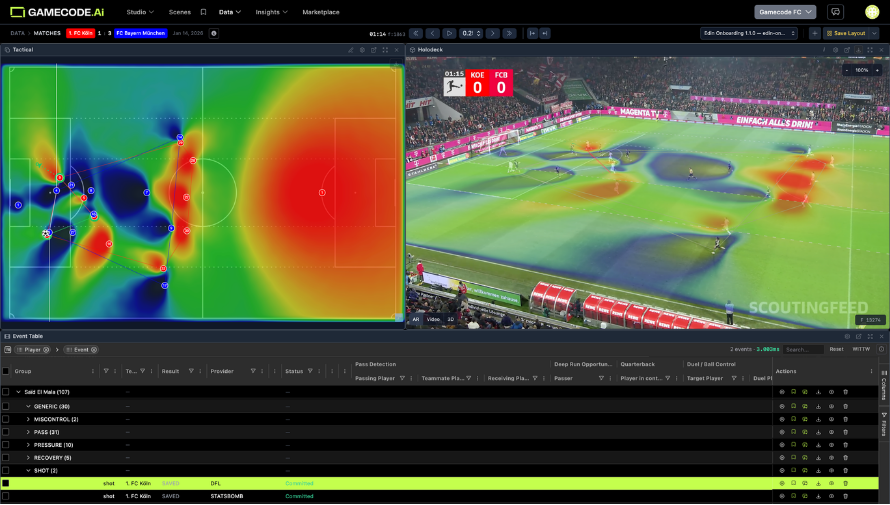
It plugs into what a club already has, rather than replacing it. GAMECODE's GC: Fusion is built to be provider- and hardware-agnostic, pooling event and tracking feeds – including official league data from Second Spectrum, Tracab and Sportec Solutions, and existing tools like SkillCorner, Hudl or Opta – into one place, alongside its own camera-captured training data. And because sophisticated models only matter if people can act on them, the output comes as usable benchmarks, scouting filters and team reports a coach or sporting director can take onto the training ground the next morning. A natural-language copilot, GC: Pulse, then lets staff simply ask questions of that proprietary data in the moment, rather than waiting on a report.
This is not only theory. Edin Terzić, who reached the 2024 Champions League final with Borussia Dortmund, built his analysis around his own definitions on GAMECODE's platform. To give one exact example: he was not satisfied with the generic definition of a cross, so with his team he defined seven distinct types and prioritised them by how and when they mattered. Across his full “What It Takes to Win” framework, that approach has produced more than 140 bespoke metrics across over 20 categories, surfacing player actions that standard statistics never recorded before. A top Premier League Club is implementing the same personalisation approach across its training ecosystem, with other leading teams in Europe from Germany and Switzerland also involved.
Where and how identity-based football analytics changes decisions:
The clearest way to see the value is through the people who make the calls each week: the analyst, the coach, the scout and the sporting director.
An analyst in day-to-day operation can measure how accurately the team actually played the way the coach intends, not just whether it won. Preparing for an opponent becomes a matter of testing the club's own patterns against theirs, and post-match review becomes a check on identity as much as on the result. Training footage can be captured too, with the habits behind performance measured session by session, not only from ninety minutes on a Saturday.
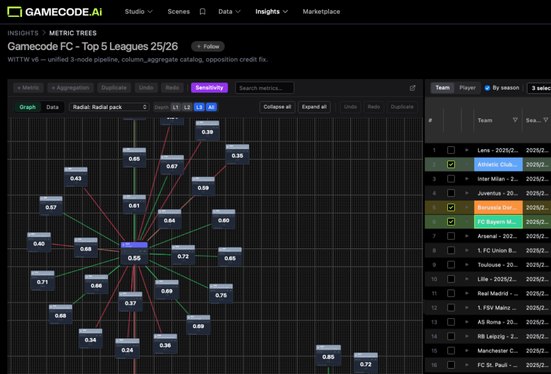
There is real depth to how this can be done. GAMECODE.Ai structures the whole game as a hierarchy of building blocks. At the top there are two main blocks: attacking and defending. Each breaks down into sub-phases (five each), one of which is “transition (defending),” which breaks even further into specific and measurable actions – possession won in zone three, loose-ball recovery, opposition early cross, and many more. With this structure, any moment on the pitch can be traced down to a precise, defined action by any player.
Recruitment can move from “is this a good player?” to “is this the right player for how we play, alongside the players we already have?” Once a club has defined the metrics that describe its style, it can assess any target through that exact lens, and model how a signing would perform inside the current squad. For a scout, that means a shortlist built around fit rather than reputation. For a sporting director, it means recruitment decisions that are easier to justify and less likely to become expensive mistakes.
In academy development, the same playing philosophy can run from the U15s to the first team. Each young player can be developed against benchmarks drawn from the senior side's identity, with specific qualities targeted at the right age. If the first team is short of a particular profile, the club can see who in the academy is on track to fill it, and in what timeframe.
A federation has to align a whole ecosystem – national teams, elite youth, grassroots and coaching education – around a shared identity. Today, talent identification is often inconsistent from region to region, coaching methodology is hard to quantify, and player development is judged by opinion rather than evidence. Defining a national playing philosophy in measurable terms gives every stakeholder the same reference points, turning a philosophy that usually lives at the top into a common language used across the whole country.
The future of football analytics:
Football analytics first helped clubs and federations measure the game. The next era will help them define their own version of it. What makes this moment exceptional is that the capability is already available; it builds on the data and infrastructure clubs already have, rather than asking them to start again, while keeping full ownership of everything it creates. As access to data and AI keeps levelling out, the lasting advantage will belong to the clubs that use them to sharpen their own identity, rather than to sound like everyone else.
Key takeaways:
More data has not automatically meant more clarity. Most football clubs draw from the same pool of standardised metrics, which pushes them toward the same players and the same conclusions.
The next advantage is customisation, not access. As data and AI tools spread, the edge comes from collecting, processing and interpreting data around a club's own philosophy – not from having more data than the next club.
Around 99% of the game is still under-measured. Off-ball movement and training are largely invisible to standard analytics, and that is where much of the untapped value sits.
Identity-based analytics changes real decisions. It sharpens day-to-day tactics, makes recruitment about philosophy fit rather than reputation, and turns the academy into a deliberate pathway to the first team.
Ownership matters. When a club defines its own metrics on a provider-agnostic platform like GAMECODE.Ai, the intellectual property – and the competitive advantage it represents – stays in-house, not with the vendor.
Frequently asked questions
What is the difference between generic and customised football analytics? Generic analytics apply the same standard metrics, such as xG or possession share, to every club. Customised analytics let a club define its own metrics and event sequences in its own terms, so the data describes how that particular team tries to play, and stays unique to it.
Why do off-ball and training data matter so much? The ball is with one player at a time, so standard event data captures only a small fraction of a match. Most of the game, the runs, positioning and decisions made away from the ball, and almost all of training, goes unmeasured. Capturing it opens up a large amount of previously hidden insight.
How does customised analytics help with recruitment? Instead of judging targets against generic benchmarks, a club can assess every player through the exact profile its system needs, and model how that player would perform alongside the current squad. This lowers the risk of expensive mismatches and makes better use of the transfer budget.
How can federations use identity based analytics? Federations can define a national playing philosophy in measurable terms and apply it consistently from youth level to the senior national team. This gives every region, scout and academy a shared reference point, making talent identification and player development more consistent across the country.
What is GAMECODE.AI? GAMECODE.Ai is an AI-driven sports intelligence platform that lets federations, leagues, clubs, coaches, scouts and analysts build proprietary KPI systems, track matches and training sessions, analyse off-ball behaviour, connect insights to video evidence, and interact with their data through AI – while keeping full ownership of the data and metrics they create.
What kind of data does GAMECODE.AI analyse? GAMECODE.Ai combines video, event data, wearable data, and positional and skeletal tracking — from official league providers, existing club data suppliers, and its own camera-based training capture — with market information from professional and club-internal sources. Key outputs include movement heatmaps, tactical shape analysis, physical load metrics, and predictive performance scores.