
Our take on Bundesliga’s new AI App feature "Captain" & Kings League pausing Spain edition
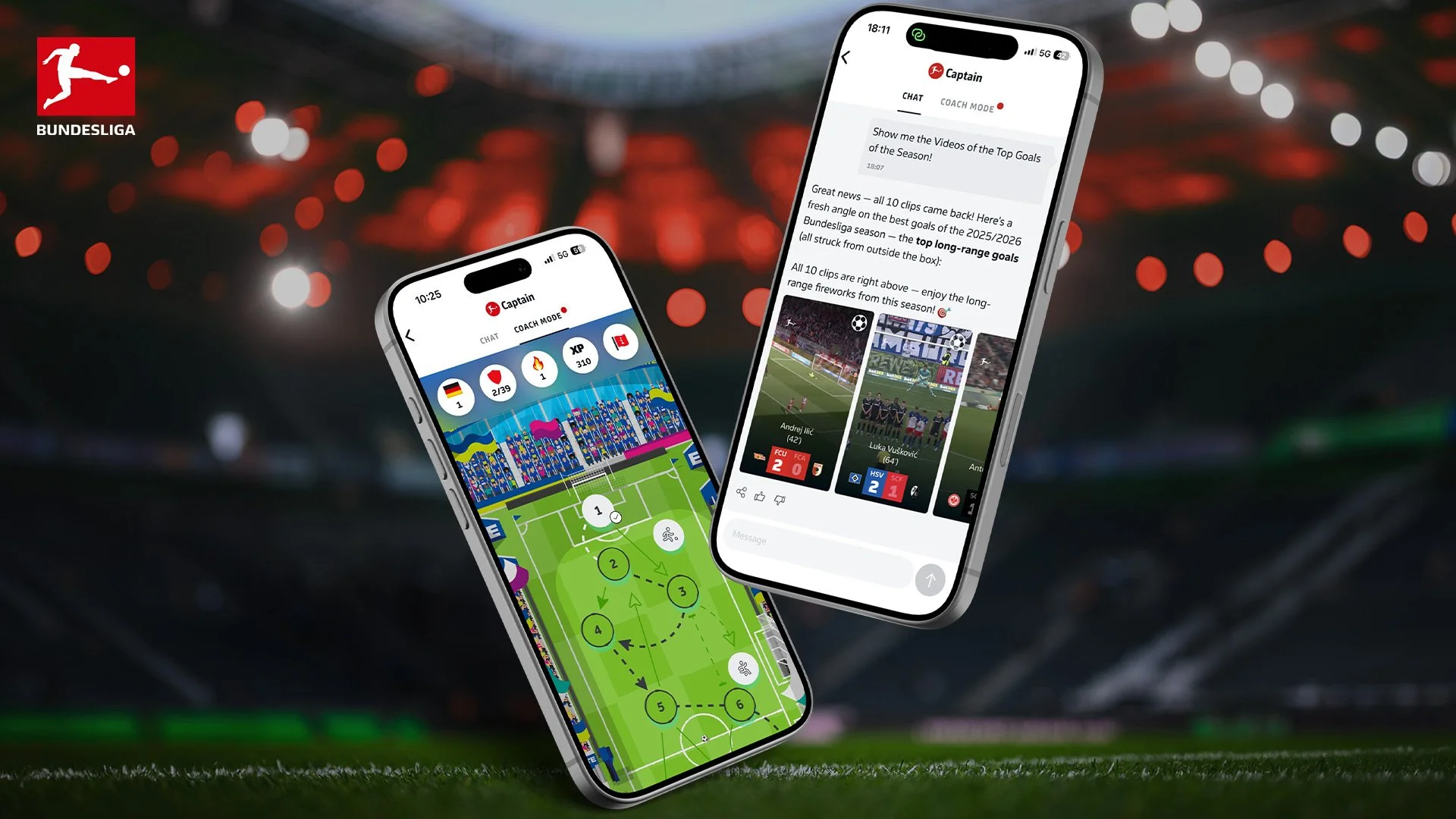
Smart companion for fans in the Bundesliga app: New AI feature “Captain” provides video content, data and historical knowledge on individual request
The Bundesliga’s new AI feature sets a new standard for how leagues are evolving their digital platforms.
Leander Monbaliu, our CBO, explores what this says about the next phase of fan engagement, platform ownership and the role of AI in helping sports organisations build deeper direct relationships with fans.
Our Take:
The Bundesliga is expanding its official app with a new AI-powered feature developed in collaboration with AWS. The tool called “Captain” is built directly into the league’s own platform, and will act as a smart companion that connects fans to the Bundesliga’s content, data and history through a simple chat-based experience.
Instead of searching separately for stats, videos, highlights or match context, fans can ask Captain what they want to know in their own words. A fan could ask for a player’s best goals, a comparison between two strikers, the story behind a historic fixture or the key numbers from a live match. Then Captain will be using Bundesliga’s data, video content and historical knowledge to give a relevant answer, while also guiding fans towards recommendations and gamified elements, such as quizzes based on their interests, previous actions and preferred clubs.
With this innovative feature, the real story here is not just that the Bundesliga is adding AI to its app. It is that the league is using AI to make its own platform more personal and more accessible for different types of fans.
Some fans follow every match, know the history, understand the tactics and want deeper data. Others may just discover the Bundesliga through a player, a match moment or a social clip. From another perspective, some are local and highly engaged. While others are international, casual, curious or even still learning the game. Captain’s real innovation and value lies in the ability to bring all of these fans into the same environment without asking them to behave and engage in the same way.
A long-time Bundesliga fan can use it to go deeper into match data or tactical patterns. A newer fan can use it to understand rules, players and storylines in a more natural way. A Colombian fan might look for Luis Díaz’s highlights from his last match. While an English fan might search for Harry Kane’s top 5 goals. Then a neutral fan arriving through social media might ask basic questions. What is the common between all of them? They all feel included. The same platform can serve all of them, but the experience becomes different for each user.
This is the next step in personalisation. Beyond recommending content because someone watched a video before, but adapting the whole fan journey around their knowledge, interest and context.
It also says something important about platform ownership. Fans already consume football across many fragmented spaces: social platforms, stats websites, highlight clips, group chats and broadcast feeds. Captain does not try to replace all of that behaviour. Instead, it gives the Bundesliga a stronger central point inside its own app, where data, video, history and storytelling can come together.
That matters because owning the platform also means owning more of the narrative. When fans search for context, compare players, explore archives, or follow live moments, the league has the opportunity to guide that experience with official data, relevant content and its own perspective. AI becomes less of a standalone feature and more of a new interface between the fan and the league’s ecosystem.
But Captain doesn't come from nowhere. What makes it possible is years of investment in data infrastructure, content architecture and platform ownership. The Bundesliga has built, and continues to build, the foundations that allow AI to actually work: structured data, owned video, historical records, and a direct platform relationship with fans. AI is only as good as the assets it can access. Without that infrastructure layer, a feature like Captain would have nothing meaningful to draw on. The leagues that will lead in AI-powered fan engagement are not necessarily the ones that move fastest on a new feature. They are the ones that have done the harder, less visible work of owning their data and their platform. Captain is the visible tip of a much deeper infrastructure story.
However, it is about more than just the narrative. By making the app more useful, more personal, and more attractive to fans, the league also strengthens its direct relationship with fans. The more fans use the app to discover content, the more the Bundesliga can understand their interests, behaviours and needs. Ultimately, this leads to more effective and broader monetisation opportunities.
On a broader level, this is another example of the Bundesliga setting the standard for innovation in European football. The league has consistently treated technology as part of its long-term growth strategy, not just as a communication tool. This news connects closely to our collaboration, supporting the governing body in innovation and digital transformation. The objective is to help structure, evaluate, and scale innovation in a way that strengthens the league's long-term competitive position and turns market intelligence into actionable business opportunities.
Captain fits into this wider story. It extends beyond being a new AI feature in an app. It is a representation of a league building the tools, platforms and habits to deepen fan engagement and understand its audiences better to ultimately leverage these relationships.
Key takeaways:
AI personalisation goes beyond recommendations by adapting the fan journey to each fan’s knowledge, interest and context.
Owning the platform gives the Bundesliga more control over the narrative, the fan relationship and the data behind it.
Captain shows that AI-powered fan engagement depends on strong foundations: structured data, owned content and a direct relationship with fans.
Kings League cuts jobs and pauses Spain edition
Kings League’s latest restructuring goes beyond simple cost-cutting. It raises bigger questions about the next phase of creator-led sports formats.
Simão van Zeller, our Business Development Manager explores what this moment reveals about attention, growth and the challenge of turning a new football product into something to last.
Our Take:
The views were never the hard part for Kings League.
Two years ago I was optimistic about Kings League. The format was clever, the streamer-led distribution was genuinely new, and the growth was real. That still holds. But the news this month is a reminder that building an audience and building a business are two different jobs, and Kings League has only finished the first one.
The company is cutting around a third of its Barcelona staff, 41 of 125 roles, and pausing Kings League Spain for at least six months. A group of employees put the cuts closer to half the workforce and said France and Germany are paused indefinitely, accusing management of giving the press "a sugar-coated and unrealistic version". CEO Djamel Agaoua framed it differently, calling it "a perfect opportunity to pause and dedicate the next six months to focusing all our energy on developing a new product".
None of this surprised us, because we have seen it before. In February, Baller League, the rival short-form league paused its German edition, saying the market "does not offer the necessary size and structural conditions to support the company's long-term goals" and to focus on US and UK markets, where the model seems to be holding up, yet. Two of the loudest new football formats hitting the brakes within four months is not a coincidence. It is the same lesson arriving twice.
Here is the lesson. A shiny product full of celebrities and familiar faces gets you a launch. Kings League has the launch numbers that get cheques signed: €52m in revenue last year, $160m raised across three rounds, and 85% of its audience under 35. What it does not have is profit, and three-quarters of that revenue still comes from sponsors while media rights bring in barely 5%. Sponsorship money follows attention, and attention is rented, not owned. The moment the novelty cools, so does the inventory.
This is the part that should worry anyone building a league from scratch. Getting people to care about a sport that already exists is hard enough. Manufacturing that loyalty from nothing, on the strength of who is in the room rather than what happens on the pitch, is a far steeper climb. Streaming services learned this the expensive way. Plenty of shows get a huge opening weekend. Far fewer earn a second season, and the ones that do are built on story and characters people come back for.
So Agaoua is asking the right question, even if the circumstances forced it on him. You have the views and the partners. Now what? Where is the product, the rivalry, the story that brings a fan back next week without a famous name dragging them there? Six months is not long to answer that, and the answer matters well beyond Kings League.audiences better to ultimately leverage these relationships.
Key takeaways
Audience growth can create momentum, but it does not automatically create a sustainable business model.
New sports formats need more than novelty, celebrities and launch numbers; they need stories, rivalries and habits that make fans return.
Kings League’s pause shows that attention is only valuable long term when it can be converted into owned relationships, diversified revenue and real fan loyalty.
LaSource exists to help those shaping the next era of sport. We help sports organisations, technology companies and investors grow their business in sport through strategy, digital transformation and ecosystem partnerships. By combining strategic foresight with hands-on execution, we turn long-term ambition into initiatives that can actually be deployed and scaled.